Advocating for Music Education

Learning Outcomes
The TEAM project has developed a set of Learning Outcomes for Music Teacher Education in Europe, for both generalist and specialist classroom music teachers in primary and secondary education. This set is useful for curriculum work in music teacher education. It serves as a European reference framework. It can also be useful for in-service professional development, and as a means of advocating for classroom music education.
Below, you can consult and test the set, in our dynamic tool. You can also find inspiration on how to use this new reference document, and read more about its data-driven development.
Descriptors
The set is composed of Core and Transversal Descriptors that are mutually interlinked. Each Transversal Descriptor should be considered in relation to all Core Descriptors. Combining both types of Descriptors can help to bring potential music teachers’ activities to light.
In the dynamic tool below, you can tick a Core Descriptor in the first column and a Transversal Descriptor in the second column, which will result in a possible professional activity in the third column. Please note that these are only random examples.
CORE DESCRIPTORS
-
1Be a role model:Inspire learners with one’s own musicianship and artistic open-mindedness.
-
2Assist musical journeys:Support learners in exploring their interests and achieving their musical goals.
-
3Co-create plans for progression:With students, create plans for their musical progress, taking into account their needs, competences and interests.
-
4Connect with musical cultures:Understand and respond to the role of music in young people's lives in and outside school.
-
5Enrich school and community life:Create musical opportunities that connect school life with life outside school.
-
6Foster musical creativities:Enable learners, collaboratively and individually, to be inventive and inquisitive, and to express and develop their musical ideas.
-
7Compose, improvise, produce, and arrange:Create music with an understanding of stylistic, theoretical and technical requirements, and learners’ needs, musical competences and interests.
-
8Use engaging materials and approaches:Select, adapt, or create appropriate music materials and methods to create meaningful music learning experiences.
-
9Facilitate varied music making:Confidently lead singing and instrumental music-making activities.
-
10Perform expressively:Communicate music confidently and fluently, vocally and instrumentally, exploring different styles, and adapting to diverse learning environments and audiences.
-
11Accompany musically:Play an accompanying instrument (such as piano or guitar) to support learners' musicking.
-
12Lead ensembles: Guide and assist vocal and instrumental groups in rehearsals and performances.
-
13Promote active music listening:Offer learners different modes of listening and engage them in shared listening experiences.
-
14Teach key elements of music:Help learners understand and use musical elements within musical experiences.
-
15Read and write music:Read and write music in traditional and alternative notations and use these to communicate musical ideas.
-
16Communicate well:Use clear and encouraging musical, verbal and non-verbal communication modes to foster learning.
-
17Promote well-being:Plan with awareness of the impact of music and music education on learners' physical and mental health, and social issues relating to music.
-
18Manage the music classroom:Manage the music classroom: Design and facilitate learning activities in diverse group settings, ensuring a positive and safe classroom environment.
-
19Ensure coverage of curricula:Have a strong awareness of relevant curricula aims and educational policies, particularly those related to music.
-
20Assess and feed back:Choose appropriate forms of assessment for music education, to provide feedback in order to guide learning.
TRANSVERSAL DESCRIPTORS
-
AFoster inclusivity and celebrate diversity:Acknowledge the different layers of intersectionality in order to counter power relations, and celebrate diverse musical practices and traditions.
-
BCultivate global responsibility:Within music education, promote awareness of societal, cultural, ecological and economic evolution.
-
CUse technology where appropriate:Enhance music learning and creativity through the use of music and other technologies.
-
DCollaborate and co-teach:Work with fellow staff, diverse stakeholders and across subject disciplines to enrich the musical learning experience.
-
EEngage in continuous professional development:Take responsibility for one’s own professional growth, adopt a reflective attitude, seek feedback, and contribute to (practitioner) research to advance and innovate music education.
EXAMPLE
The following example illustrates one possible professional activity in which an experienced music teacher has drawn on both selected descriptors.
The music teacher performs a short mash-up on guitar, combining a local folk song with a student-suggested song from another cultural tradition. Students discuss whose musical voices are often heard or overlooked, then work in groups to create and perform their own inclusive mash-ups reflecting diverse identities and experiences
How the TEAM Learning Outcomes will be useful to you
Music Teacher Education
The TEAM Learning Outcomes provide an international reference for programme goals and curriculum reform. They support curriculum development, mobility alignment, and inspire seminars and learning activities for student teachers. Their concise, second-person style encourages dialogue with students, fostering reflection on their development as future teachers.
In-Service Professional Development
The TEAM Learning Outcomes can guide teachers’ reflection on their competences throughout their careers. They raise awareness of skills for effective music learning, support professional development, and help teachers advocate for its importance with school leaders. The transversal descriptors are particularly valuable for in-service development and can help transform practice.
Advocacy
The TEAM Learning outcomes can support informed discussions on curriculum priorities and serve as an advocacy tool by providing a European quality reference for music teacher education. Institutions are encouraged to use them accordingly. They are not designed to evaluate teachers or to assess classroom practice but to support reflection and teacher empowerment.
Further reading
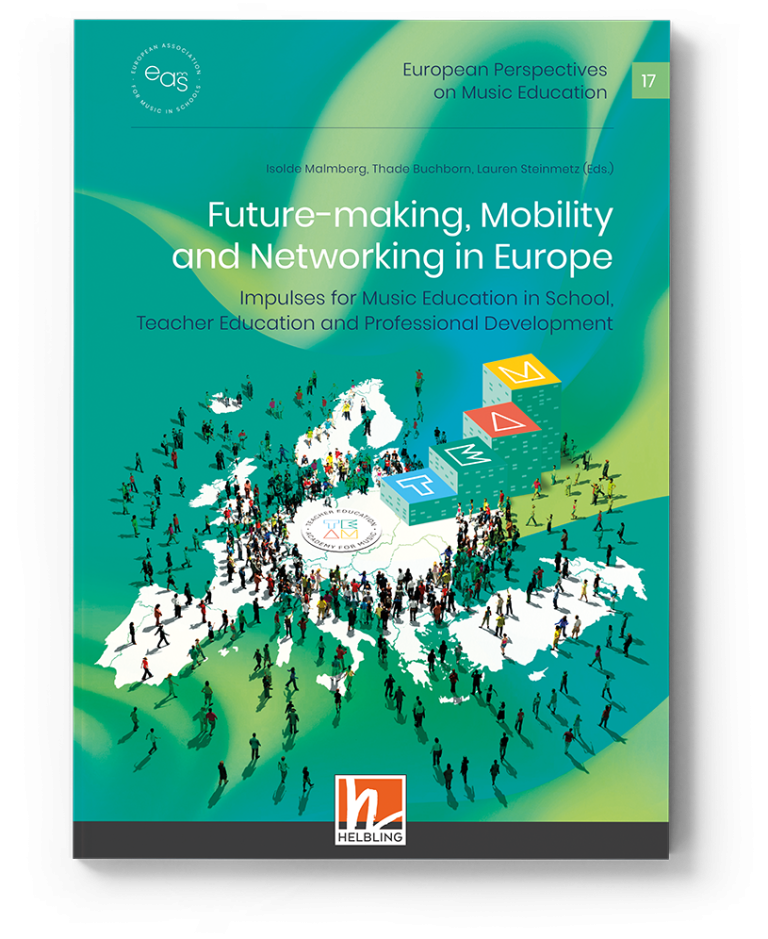
The TEAM Learning Outcomes for Music Teacher Education in Europe
This open-access chapter (2026) presents the TEAM Learning Outcomes for Music Teacher Education in Europe. It situates the new descriptors within the harmonisation of the European Higher Education Area and clarifies the principle of learning outcomes. It also introduces the key principles underlying their formulation.
Future-proof learning outcomes for classroom music teacher education: A Europeanwide exploration
This open-access article (2025) reports on our scoping review, in which we aimed to identify current and future-oriented trends in existing institutional, regional, and national sets of descriptors across Europe. This review led to the formulation of the transversal descriptors.
Advocating for Music Education: Strategies to Sustain Music in General Schools and in the Wider Music Education Sector
Isolde Malmberg, Marina Gall, Michaela Hahn & Finn Schumacker (2026). Advocating for Music Education: Strategies to Sustain Music in General Schools and in the Wider Music Education Sector.
Useful policy papers
Lorem ipsum dolor sit amet, consetetur sadipscing elitr, sed diam nonumy eirmod tempor invidunt ut labore et dolore magna aliquyam erat, sed diam voluptua. At vero eos et accusam et justo duo dolores et ea rebum.

EAS

European Education Area